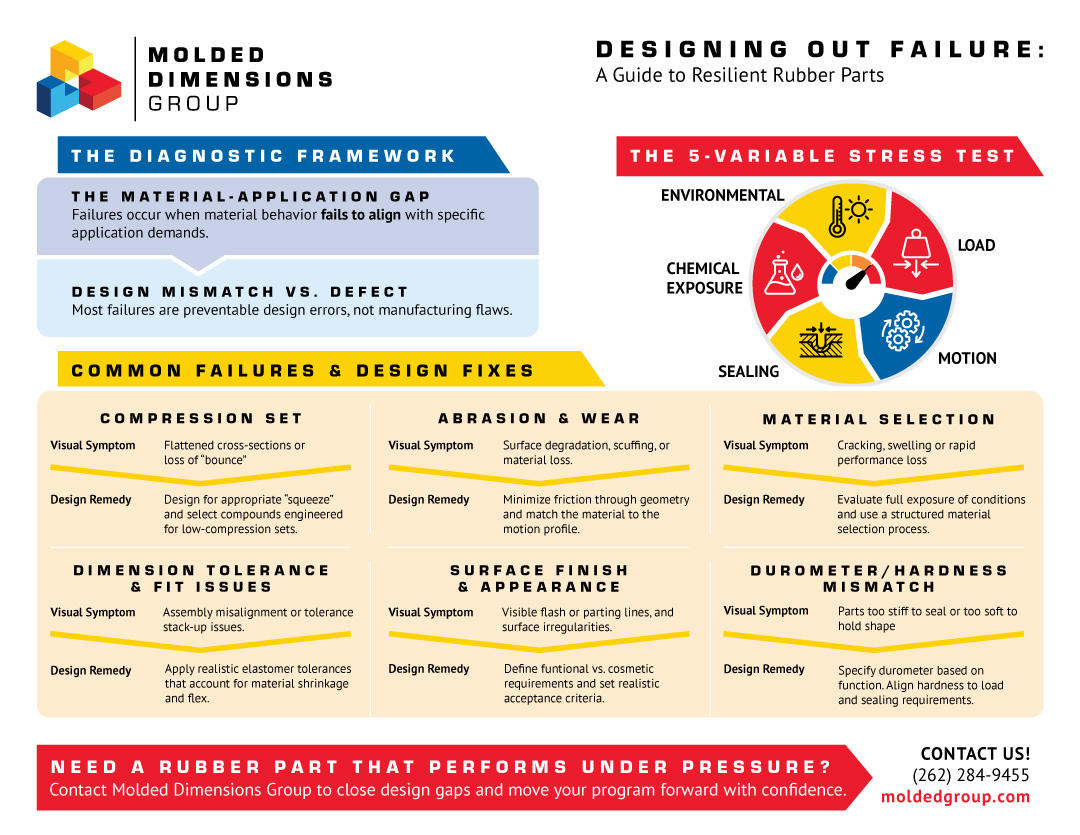
Rubber components rarely fail at random. When a seal leaks, a gasket takes a set, or a molded part wears prematurely, the root cause can often be traced back to a mismatch between design intent and real-world conditions. Most failures are preventable, if they’re diagnosed early and designed out systematically.
Why Rubber Part Failures Happen
At a high level, rubber failures occur when material behavior doesn’t align with application demands. That misalignment typically shows up in one (or more) of these categories:
- Environmental exposure (temperature, UV, ozone)
- Mechanical load (compression, tension, impact)
- Motion (static vs. dynamic contact)
- Sealing requirements (pressure, deformation, recovery)
- Chemical exposure (oils, solvents, cleaners)
A Simple Diagnostic Flow
When evaluating a failing part, or designing a new one, start here:
- Environment
- Load
- Motion
- Sealing
- Chemical Exposure
If any one of these variables is misunderstood or under-specified, failure risk increases significantly.
Compression Set (Loss of Sealing Force)
What it looks like:
- Gaskets that don’t “bounce back” after compression
- Persistent leaks in static seals
- Flattened or permanently deformed cross-sections
Why it happens:
Compression set occurs when elastomers lose their ability to recover after being compressed over time. Elevated temperatures, long-term load and poor material selection can speed up this behavior.
How to design it out:
- Select compounds specifically engineered for low compression set
- Validate performance using standardized testing (ex: ASTM methods)
- Design for appropriate squeeze, not over-compression
- Account for temperature exposure over the product lifecycle
Abrasion & Wear (Material Loss Over Time)
What it looks like:
- Surface degradation, scuffing or material loss
- Reduced sealing effectiveness in dynamic applications
- Premature failure in high-contact environments
Why it happens:
Over time, repeated motion, friction and contact with rough surfaces breaks down rubber compounds.
How to design it out:
- Match material selection to the motion profile (sliding, rolling, intermittent contact)
- Use compounds with proven abrasion resistance
- Minimize unnecessary friction through geometry or lubrication
- Consider surface interactions (mating materials matter)
Durometer/Hardness Mismatch
What it looks like:
- Parts that are too stiff to seal properly or too soft to hold shape
- Inconsistent performance across assemblies
- Difficulty achieving proper fit or compression
Why it happens:
Incorrect durometer selection can compromise sealing and structural integrity. Misunderstanding Shore A vs. Shore D scales is a common contributor.
How to design it out:
- Specify durometer based on function, not assumption
- Aligning hardness with load and sealing requirements
- Validate with prototyping and real-world testing
- Ensure consistent measurement standards across suppliers
Dimensional Tolerancing & Fit Issues
What it looks like:
- Assembly problems (parts don’t fit, seal or align correctly)
- “Failure” that is actually, a tolerance stack-up issue
- Variability across production runs
Why it happens:
Rubber behaves differently than rigid materials; it shrinks, flexes and responds to conditions. Poorly defined tolerances may create the illusion of part failure.
How to design it out:
- Apply realistic tolerances for elastomers
- Account for material shrinkage and process variation
- Collaborate early with molding experts
- Avoid over-constraining designs where flexibility is required
Surface Finish & Appearance
What it looks like:
- Visible flash or parting lines
- Surface irregularities impacting sealing or aesthetics
- Mismatch between expectation and ability to manufacture
Why it happens:
Rubber molding processes inherently produce variations in surface finish. If expectations aren’t aligned with process capabilities, perceived “failures” arise.
How to design it out:
- Define functional vs. cosmetic surface requirements early
- Choose appropriate de-flashing methods
- Design parting lines strategically
- Set realistic acceptance criteria for finish
Material Selection Process
What it looks like:
- Cracking, swelling or degradation in service
- Rapid performance loss under environmental stress
- Chemicals or temperature are incompatible
Why it happens:
Material selection may be based on incomplete data or assumptions. Even high-quality compounds can fail without fully evaluating the application environment.
How to design it out:
- Start with the probable failure mode and work backward
- Evaluate full exposure conditions (temperature, chemicals, UV, etc.)
- Use a structured material selection process
- Partner with experienced compounders early in development
Designing Failures Out Before They Happen
Most rubber part failures are not manufacturing defects; they are design mismatches. Eliminate issues before they reach production by aligning material selection, geometry and performance expectations with real-world conditions.
The most effective way to solve rubber failures is to prevent them entirely. That starts with asking the right questions early, and designing with failure modes in mind, not as an afterthought. Contact us today and we will proactively hunt down risk, close gaps and drive decisions so your molded-part programs move forward without friction.